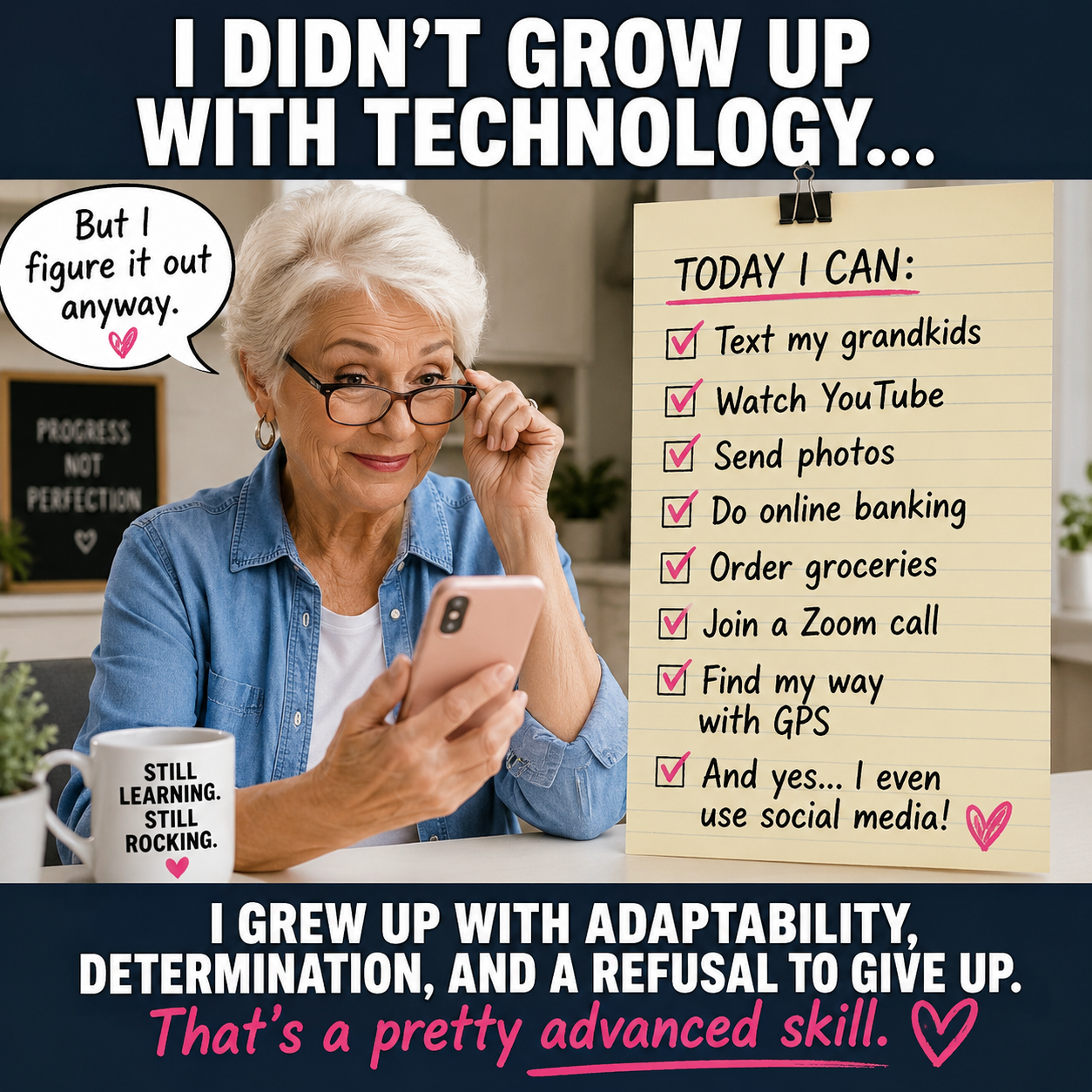
There’s a persistent myth floating around that older adults “just can’t do technology.”
I’d like to respectfully challenge that narrative.
Because from where I sit, millions of older adults are navigating smartphones, patient portals, online banking, streaming services, social media, grocery delivery apps, Zoom calls, digital photos, texting, QR codes, online dating, and passwords that now require approximately one uppercase letter, one symbol, one ancient rune, and the blood of a dragon.
And they’re doing it while the technology changes every six months.
That’s not incompetence.
That’s resilience.
The Numbers May Surprise You
According to recent Pew Research and aging-focused technology studies:
- Nearly 90% of adults over 65 now use the internet.
- Most older adults own smartphones.
- About 72% of adults over 50 use Facebook regularly.
- YouTube usage among adults 50–64 is now above 80%.
- Older adults are one of the fastest-growing groups using social media.
Let that sink in for a minute.
The image many people still carry of seniors being “offline” or disconnected is increasingly outdated.
In fact, many older adults are embracing technology not because it’s trendy, but because it helps them:
- stay connected to family
- reduce isolation
- access health care
- learn new things
- manage daily life
- remain independent longer
That matters.
The Problem Often Isn’t Aging. It’s Design.
Now let’s also tell the truth.
Modern technology can be exhausting.
Tiny print.
Constant updates.
Passwords for everything.
Apps talking to other apps.
Pop-ups.
Scams.
Notifications.
Videos autoplaying unexpectedly at full volume in public.
Most younger people get frustrated too. They just happen to have grown up inside the chaos.
Older adults often learned technology in layers:
First desktop computers.
Then email.
Then smartphones.
Then apps.
Then social media.
Then telehealth.
Then QR codes during a pandemic.
That’s a tremendous amount of adaptation in a relatively short period of time.
And frankly, many seniors are not struggling because they are incapable.
They’re struggling because the systems are not designed with aging bodies and brains in mind.
Arthritis makes tiny keyboards harder.
Vision changes make low-contrast screens difficult.
Hearing changes affect phone usage.
Memory changes can make password overload frustrating.
And fear of scams? Completely reasonable.
Many older adults are not afraid of technology itself.
They are afraid of making costly mistakes.
There’s a difference.
Some Myths We Need to Retire
Myth #1: Older adults can’t learn new technology.
False.
The human brain remains capable of learning throughout life. In fact, continued learning and digital engagement may support cognitive health and social connection.
Myth #2: Seniors don’t use social media.
Also false.
Many older adults are highly active on Facebook, YouTube, Pinterest, messaging apps, and increasingly even TikTok.
Some are building businesses.
Some are reconnecting with old friends.
Some are learning recipes, fitness routines, travel hacks, and caregiving strategies.
And some are simply enjoying funny dog videos at 2 a.m. like the rest of us.
Myth #3: Asking for help means failure.
Absolutely not.
Technology is now complicated enough that nearly everyone asks for help sometimes. If you’ve ever called your adult child because “the TV stopped talking to the internet,” welcome to modern life.
A Few Tips That Actually Help
Here are some practical things that can make technology less stressful and more useful for older adults:
1. Make the text bigger
This alone can change everything.
Most phones and tablets allow larger fonts and icons through accessibility settings.
2. Use voice commands
Talking to your device is not lazy. It’s efficient.
You can:
- send texts
- set reminders
- make calls
- ask questions
- create grocery lists
without typing tiny letters.
3. Create ONE place for passwords
Whether it’s a secure password manager or a carefully stored notebook, reducing password chaos matters.
4. Turn off unnecessary notifications
Not every app deserves immediate access to your nervous system.
5. Learn one feature at a time
Nobody needs to master everything overnight.
Learn:
- texting this week
- photos next week
- Facebook groups later
Slow learning still counts as learning.
6. Use technology to support independence
Medication reminders.
Grocery delivery.
Telehealth.
Navigation.
Fall alerts.
Video calls.
Technology can help older adults remain independent and connected longer.
The Bigger Conversation
I sometimes think the conversation about seniors and technology says more about society than it does about aging.
We celebrate teenagers for adapting to new apps.
But we underestimate older adults adapting to an entirely transformed world.
Yet many seniors today have lived through:
- rotary phones
- typewriters
- cassette tapes
- answering machines
- desktop computers
- flip phones
- smartphones
- AI
That’s astonishing when you think about it.
Aging is not the absence of curiosity.
And growing older does not mean becoming irrelevant in a digital world.
Honestly, some of the wisest people I know are figuring out Facebook while also carrying decades of life experience, resilience, perspective, caregiving, grief, humor, and adaptability.
That seems pretty technologically advanced to me.
And if all else fails?
There is no shame in asking the nearest teenager how to “unmute the thing again.”